
What’s Inside Quincy Market — Food Hall, Stalls and Vendors
Last updated: November 2026. The roster and the hours are the two things that move, so both carry the date they were read. Check the operator’s own pages before you travel.
What is inside Quincy Market is one indoor food hall: a single granite building with food stalls and vendors on both sides of a central aisle. You step in off the cobblestones — up four steps at either temple-fronted end or at the front of the central pavilion — and the hall, the stalls and the vendors are all under the roof. The one thing first-timers get wrong is the name. Quincy Market is the food hall; Faneuil Hall is the brick meeting hall from 1742 next door, and it does not sell food.
What you walk into
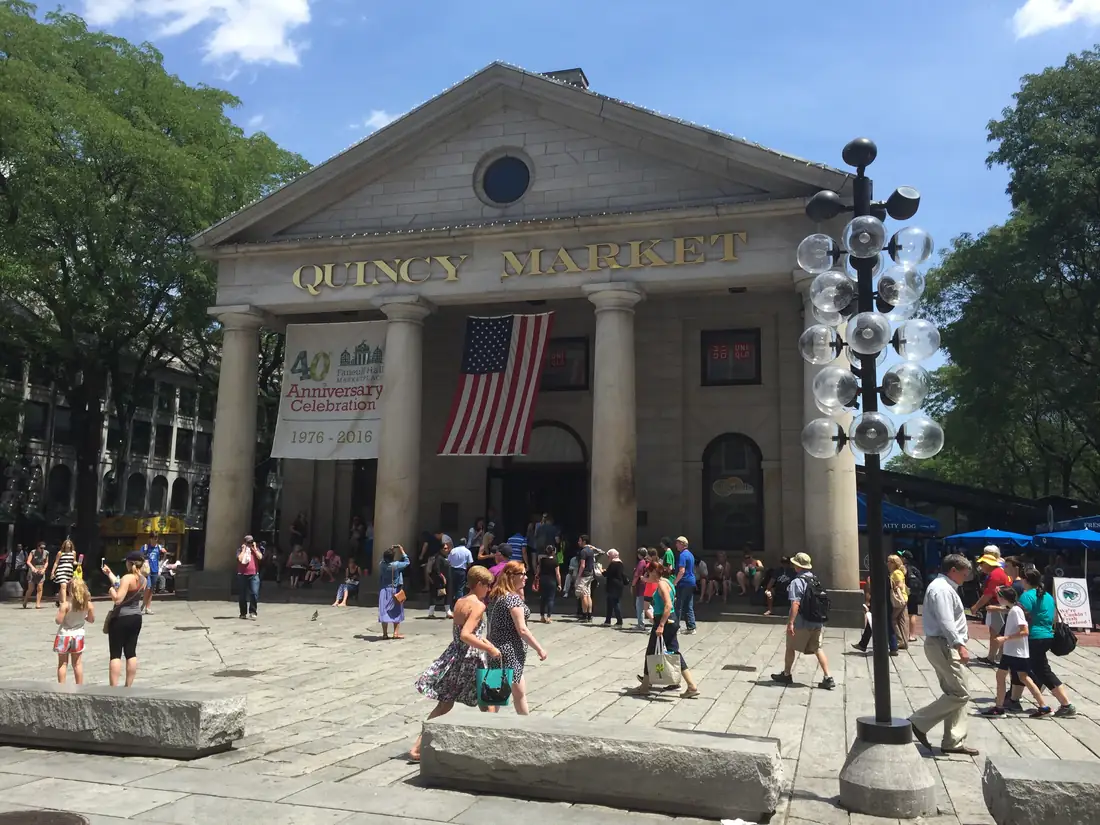
Quincy Market is the long granite building in the middle of Faneuil Hall Marketplace, completed in 1826 to Alexander Parris’s design, 535 feet long and 50 feet wide.
The counters are indoors. What is outdoors is the two pedestrian malls either side of the building — North Market Street and South Market Street, both closed to vehicles — where the pushcarts, the street performers and the summer restaurant patios are.
One central aisle, counters on both sides
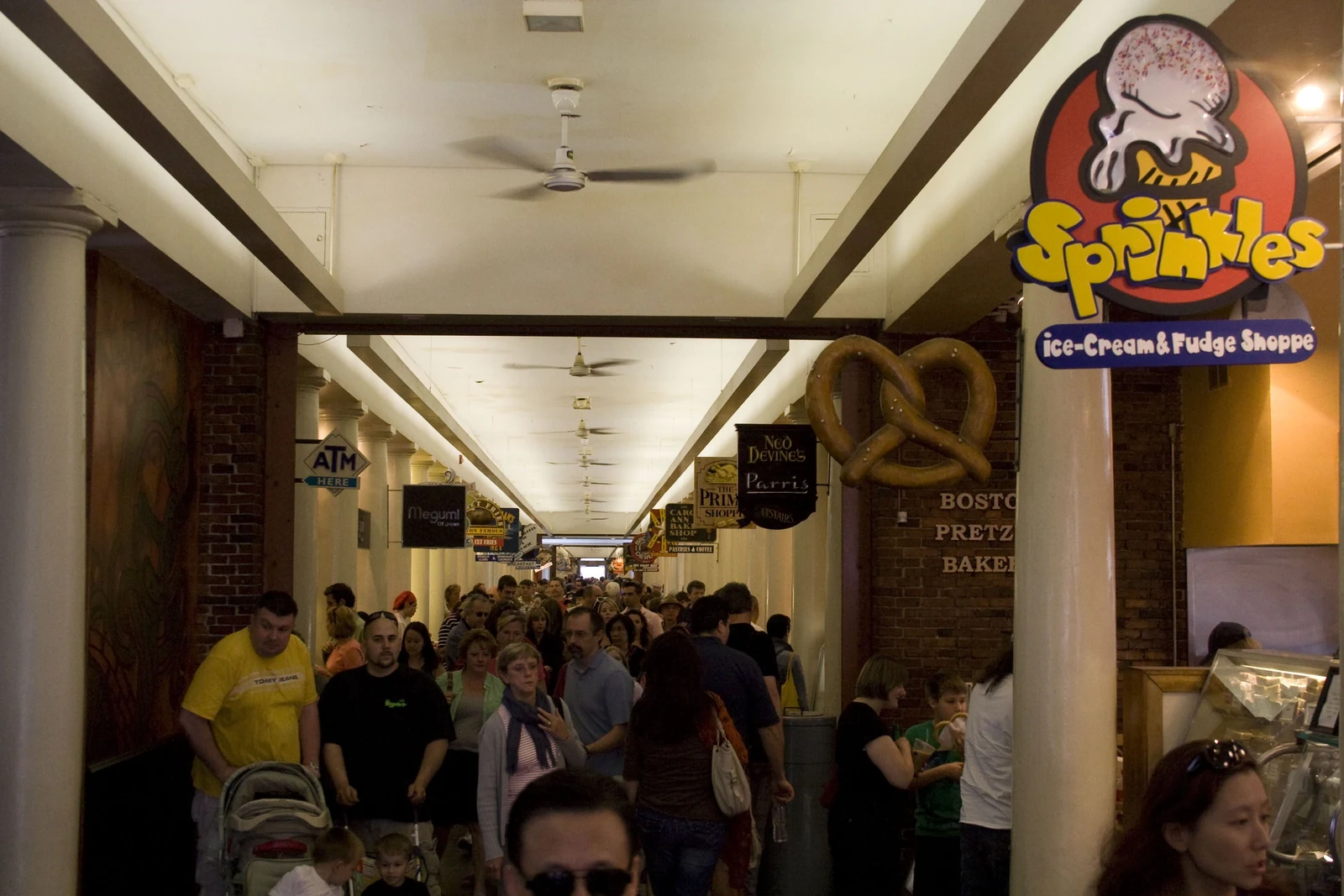
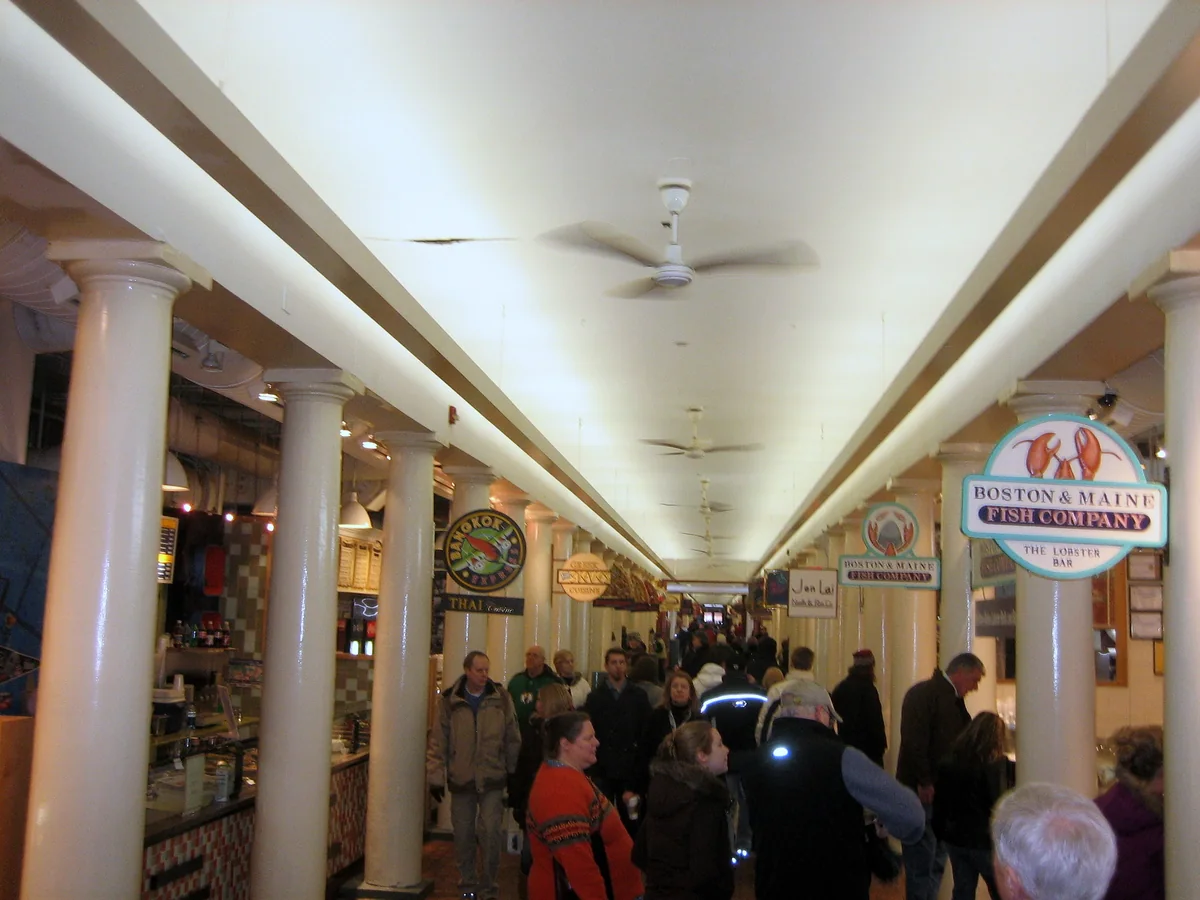
The food counters run down an enclosed central hall 512 feet long and 14 feet high, divided by two rows of cast-iron Doric columns — 59 in each row — with vendors’ stalls on both sides of the center aisle.
Come in through either temple-fronted end and the whole hall is in front of you at once: a straight aisle runs the length of the building with the counters on both sides.
Halfway along, the dome and the rotunda
Halfway along, the hall opens up under a copper-sheathed elliptical dome 70 by 50 feet on an octagonal drum; the rotunda below it is the building’s gathering space.
The entrances — four steps at each
The three main entrances — both temple-fronted ends and the front of the central pavilion — are each up a flight of four steps.
One temple front faces Faneuil Hall across the cobblestones and the other closes the far end of the building; the central pavilion door is the middle entrance on the long side.
Outside the doors: two malls and three other buildings
Everything else in the complex is a separate building: North Market and South Market are the granite-faced ranges flanking Quincy Market, and Faneuil Hall, the brick meeting hall from 1742, stands at the west end.
Built for stalls in 1826
The complex dates from 1826, when the market opened with 128 food stalls on the ground floor and exhibition space above; the City’s 1996 designation report records that it reopened on 26 August 1976, its 150th anniversary, as one of the first “festival marketplaces” in the nation.
The operator calls Quincy Market “the largest and oldest food hall in the country” and “the first food hall in the United States” — its own marketing, not an independently measured claim.
Who is in there
The operator’s tenant directory, read on 9 November 2026, lists 24 counters in the group it calls the Quincy Market Food Colonnade — the food hall. Here they are, in the operator’s order, each with the description it publishes about itself; where a counter publishes none, the row says so rather than guessing.
| Counter | What it sells — the counter’s own description |
|---|---|
| Bakey Babka | Braided babka and pastries; the only Bakey Babka location that carries the Boston Cream Babka year-round |
| The Berry Twist | Desserts, frozen treats and fresh fruit |
| Boston & Maine Fish Company | Steamed lobster, clam chowder and lobster rolls; in business since 1984 |
| The Boston Chipyard | Chocolate chip cookies, made for over 33 years |
| Boston Chowda | New England-style comfort food for over 25 years — an award-winning clam chowder made with local surf clams and hand-cut potatoes, Maine lobster rolls, pot pies, wraps, sandwiches, salads and soups |
| Boston Scoops | Ben & Jerry’s ice cream and Smith Family popcorn from Cape Cod |
| The Dog House | Italian, German, Polish and Cajun sausages, and all-beef hot dogs |
| El Paso Enchiladas | No description published |
| Jen Lai | No description published |
| Joey’s Gelateria | Italian gelato and sorbet |
| KongDog | No description published |
| Megumi | No description published |
| Monkey Bar | No description published |
| Naughty Waffle | No description published |
| North End Bakery | North End-style calzones and pizza squares, with desserts, coffee and espresso |
| Oyster Bar | No description published |
| Pokeworks | Build-your-own poke bowls and burritos |
| Prime Shoppe | American turkey sandwich, Chicken Caesar wraps and ribs; established 1955 |
| Regina Pizzeria | Brick-oven pizza, baked the same way since 1926 |
| Steve’s Greek Cuisine | Greek-style dinners, salads and wraps |
| Ueno Sushi | Sushi, sashimi and other Japanese dishes |
| Vivi Bubble Tea | Taiwanese bubble tea — milk teas, flavored teas and slushies — plus snacks such as popcorn chicken and takoyaki |
| West End Strollers | Roll-ups, panini, pasta and salads |
| Wicked Lobsta | Lobster rolls and lobster mac and cheese; established 2019 |
That is the whole directory group: every counter is either described above or marked as publishing nothing. Seven fall into the second group — El Paso Enchiladas, Jen Lai, KongDog, Megumi, Monkey Bar, Naughty Waffle and Oyster Bar — and their operator pages carry no description of what they sell.
Treat that list as the position on 9 November 2026, not a guarantee: the operator announced further Quincy Market openings in May 2026 that its own directory still did not list in November, and the directory itself has not been static. The current roster is the operator’s own tenant directory, which is the page to check on the day you go.
The operator’s own numbers for the hall do not agree with each other — 24 counters in its directory, 30 food entries in its dining index, and “over 25 local eateries” on its homepage — so any count is worth only as much as the page it was counted on.
The four sit-down restaurants, by building
Four table-service restaurants are listed, and they are spread across all three buildings: Ned Devine’s Irish Pub and The Salty Dog in the Quincy Market building, Margaritaville in the North Market building, and Sugar Factory in the South Market building.
Food is concentrated in the Quincy Market building. The North and South Market buildings are mostly shops, with one restaurant each (the North Market building also lists Ben & Jerry’s).
No stall numbers, and no plan to put them on
The operator publishes no floor plan, no stall numbers and no counter-by-counter location, so no counter can be placed at a numbered spot in the hall.
Hours and access
Hours as published by Faneuil Hall Marketplace, read on 9 November 2026:
| What | Hours |
|---|---|
| Quincy Market food hall (all counters) | Mon–Sat 10am–9pm · Sun 11am–7pm |
| Margaritaville (North Market building restaurant) | Daily 11am–midnight |
The marketplace publishes one building-wide hours block for the whole complex, with the warning that “holiday, restaurant, and retail hours may vary”.
The same hours, with the operator’s holiday caveat, are on our Quincy Market opening hours page.
The counters do not publish hours of their own: their pages carry that same building-wide block. The restaurant Margaritaville does publish its own — daily, 11am to midnight — which is a reminder that a restaurant’s hours are not the hall’s.
There is no 2026 closure or special-hours notice: the operator’s 2026 holiday programming is published as events, not as hours.
Getting there: State, Haymarket and Government Center
The marketplace describes itself as “a short walk from the State, Haymarket, and Government Center MBTA Stations”, and its directions page gives addresses for five stations and routes the Red Line to Park Street. Addresses are as read on 9 November 2026:
| MBTA station | Address on the operator’s directions page |
|---|---|
| Aquarium | 183 Atlantic Ave and State St |
| Downtown Crossing | Washington St and Summer St |
| Government Center | Cambridge St and Court St |
| Haymarket | 136 Blackstone St |
| State | 200 Washington St |
For the step-by-step version — which line from which station and the walking routes — see our how to get to Quincy Market guide; parking near Quincy Market is on its own page.
Steps, step-free access and restrooms
All three main entrances are up four steps, as described above. The operator publishes no accessible-route information and directs access questions to its front desk, [email protected] or 617-523-1300 x7047.
The operator publishes no restroom or ATM locations for Quincy Market; the only official restroom statement nearby is the Park Service’s, for Faneuil Hall next door, where bathrooms are in the basement and on the second floor.
There is no seating plan and no published seat count: the City’s 1996 designation report calls the rotunda the building’s primary interior gathering place, with tables and benches for eating at the market level and on the balcony above, and no counter takes reservations — the operator publishes no booking path.
What’s not there
The hall is a market rather than a restaurant, and several common expectations do not survive the walk in. These are the ones worth knowing before you go.
| What people expect | What is actually there |
|---|---|
| A ticket or an entry fee | None. There is no admission ticket and no published entry fee for the market itself |
| A reservation | No reservation path for any counter, and no booking anywhere in the dining listings |
| Table service throughout | Four table-service restaurants, listed above; everything else in the food hall is ordered at the counter, not from a table |
| Everything shut at 9pm | The building block is Mon–Sat 10am–9pm and Sun 11am–7pm; Margaritaville runs daily to midnight; the counters publish no hours of their own |
| A numbered stall plan | No floor plan, no stall numbers and no counter-by-counter location is published |
Beyond that, the operator sells one thing directly: a prepaid group meal voucher, accepted at participating merchants. Some experiences inside the buildings — escape rooms, mini-golf, pottery classes — are separately ticketed, but the operator publishes no prices for them.
Quincy Market is not inside Faneuil Hall. It is a separate 1826 building next door, and Faneuil Hall — the 1742 brick meeting hall at the west end — “does not sell food”, as the National Park Service puts it.
The Great Hall that visitors read about is the room on the second floor of Faneuil Hall next door, not a room in Quincy Market.
If you came for the comparison rather than the layout, the difference between Quincy Market and Faneuil Hall is set out on our comparison page, and best food at Quincy Market covers what to order once you are inside.
Sources checked 9 November 2026: faneuilhallmarketplace.com (tenant directory, dining index, Quincy Market Food Colonnade listing, the 24 counter pages, directions page, meal vouchers, site search) · National Park Service, Faneuil Hall FAQ · Boston Landmarks Commission, Report on the Potential Designation of Quincy Market (1996) · National Register nomination, Faneuil Hall Market.
Photographs: “Quincy mrkt inside” by Luciof, CC BY-SA 3.0 · “Inside Quincy Market” by Ben+Sam, CC BY-SA 2.0 · “Midday at Quincy Market” by j_m_d_imagery, CC BY-SA 4.0. Each is reproduced here at reduced size under the same licence.